Can I Diffuse Essential Oils Around My Cat
Wondering if you can diffuse oils around your cat? Get the direct, vet-first answer from a fellow pet owner, plus a simple plan to keep your home smelling lovely and your cat safe.
By the EssentialTail Team — pet owners, Wellness Advocates & doTERRA enthusiasts
I remember the exact moment I unboxed my first diffuser, absolutely thrilled to fill my home with the crisp aroma of peppermint and wild orange. Then my cat, Luna, strolled into the room, and a little voice in my head asked, “Wait… is this actually okay for her?” If you’re reading this, you’re likely in the same boat, holding a beautiful bottle of oil in one hand and a healthy dose of “better safe than sorry” in the other. You’re right to ask.
The direct answer is that diffusing essential oils around a cat is incredibly risky, and the safest default recommendation from veterinarians is simply not to do it. Cats lack a crucial liver enzyme (glucuronyl transferase) needed to process many of the natural compounds found in essential oils. Since they cannot efficiently break these compounds down, they can build up in their system to toxic, and sometimes fatal, levels. What smells like a gentle, natural aroma to us can be a serious, invisible hazard for them.
A Tale of Two Species, A Quick Comparison
It’s easy to assume that because dogs are sometimes around diffused oils, cats must be similar. This is a dangerous oversimplification. Dogs have a much stronger ability to metabolize certain compounds that are a dead-end for a cat’s liver. Here is a critical look at the difference:
| Factor | Dogs | Cats |
|---|---|---|
| Liver Metabolism | More robust; can process many compounds. | Deficient in glucuronyl transferase; cannot process many compounds, leading to build-up. |
| Oil Risk Profile | Higher tolerance, but many oils are still unsafe. Dosing is a vet-only topic. | Extremely high risk. Even "gentle" oils and low-level diffusion require extreme caution. |
| Known High-Risk Oils | Tea Tree, Pine, Wintergreen, Peppermint, Clove. | All of the dog list, PLUS most citrus oils (Lemon, Wild Orange, Bergamot), Eucalyptus, Oregano, Thyme, Cinnamon. Even oils I adore, like frankincense, can be a concern. |
| Diffusion Rule | Diffuse only in large, well-ventilated rooms the dog can leave. Vet approval first. | The safest rule is not to diffuse in a home with a cat. If you must, extreme protocols are needed. |
This isn’t about being alarmist; it’s just understanding the very real biological difference sitting on your sofa. I don't diffuse at all in the main living area where Luna spends her time. My own personal diffusion practice is confined to a home office she can't access, and I use a diffuser with a timer and the lowest mist setting, running it for a very short period. This is my personal, vet-reviewed choice, not a recommendation for you.
A Safer Way to Enjoy Your Oils, A 5-Step Plan
If you share a home with a cat and still want to enjoy doTERRA’s remarkable purity and aroma, you need a strict, vet-first protocol. I think of choosing doTERRA for its quality (I genuinely trust their CPTG testing); that quality deserves a responsible approach. Here is the step-by-step framework I follow:
- Talk to Your Vet First: Before you even plug in a diffuser, have an open conversation with your veterinarian. Tell them exactly which oils you're considering. They know your cat's specific health history. This is the non-negotiable first step. Learn more about creating a safe home in our guide to Essential Oils Safe for Cats Around the House.
- Create a Cat-Free Diffusion Zone: Never diffuse in your cat’s favorite room. Choose a space, like a bedroom or home office, where you can close the door. This becomes your personal aromatherapy sanctuary. A cat should not be napping on the pillow in a room with an active diffuser.
- The "Road Test" with Plain Water: Before using a single drop of oil, run your diffuser with only water in the secured, closed room for an hour. Watch your cat’s behavior. Are they suddenly avoiding the hallway near the door? Are they sneezing or pawing at their face? If they show any aversion, the answer is clear: don't use oils in there.
- If You Proceed, Use a Vapor Lock: Choose a diffuser that creates a cool micro-mist (an ultrasonic one) instead of sending larger droplets into the air, and place it on a high shelf your cat can't reach. Use it only with the door closed and for a very brief session, we’re talking 15-20 minutes, max.
- Know the Emergency Plan: I keep my vet’s number and the Pet Poison Helpline saved in my phone. If I ever saw my cat drooling, vomiting, wobbling, or struggling to breathe, I wouldn't spend a single second searching online. I would scoop her up and go straight to the emergency clinic. Every second counts.
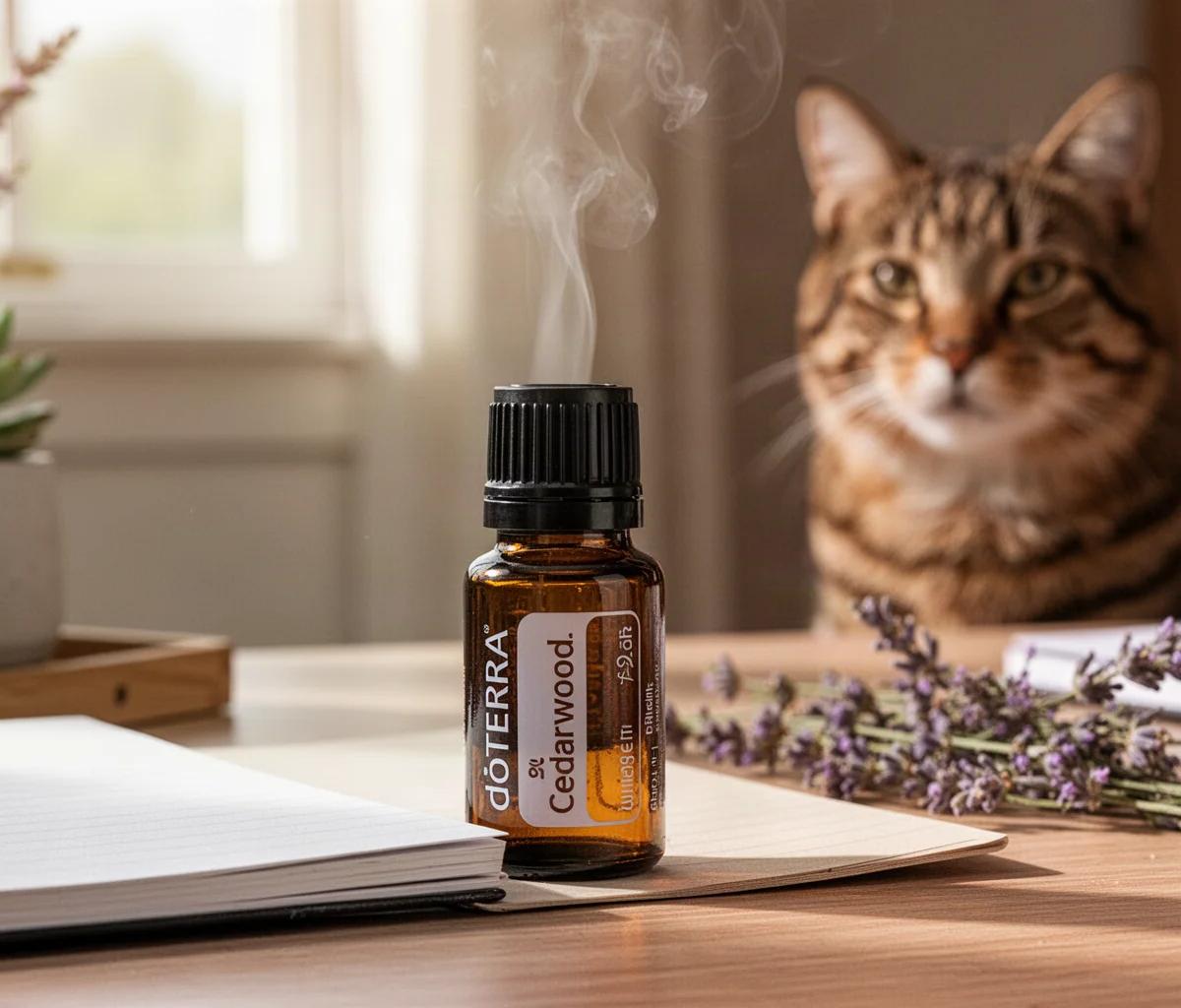
When it comes to the oils themselves, my personal collection has shifted. I still love the warm, woody aroma of doTERRA's Cedarwood and the soft, herbal notes of Roman Chamomile for my own personal, cat-free space. The grounding aroma of Vetiver is another one I keep securely capped in a separate room. For a skin-soothing option for myself, I might reach for a pre-diluted roll-on like Copaiba Touch or Tea Tree Touch, ensuring my hands are completely washed before I touch my cat. And for deeper dives into my own daily wellness, I rely on the non-aromatic supplements like the Lifelong Vitality Pack and xEO Mega, which carry no airborne risk at all. If you want a deeper look at the dynamics at play, our article on Diffusing Oils When You Live With a Cat walks through the practical reality.
Related reading
Frequently Asked Questions
My cat left the room, so is it safe to diffuse? A cat leaving the room is a good sign they are self-regulating, but it’s not a green light. The airborne oil droplets and their residue can linger for hours on soft surfaces and in the air long after the diffuser stops. Even a "safe" oil can become an overwhelming, constant exposure for a cat.
Can I just put the diffuser up on a high shelf? Placing a diffuser high up is a better practice than putting it on the floor, but it does not make diffusion safe. The mist isn't heavy; it disperses throughout the entire room’s air volume. A cat is breathing that air whether they’re on the floor or on the top of the cat tree.
What if I use only one drop of lavender? A single drop still releases hundreds of volatile aromatic compounds into a contained space. A cat’s system doesn’t filter this as a "small amount", it registers it as a chemical invasion it cannot process. There is no known "safe drop count" for cats, as their sensitivity varies wildly by individual, which is why I never guess with numbers.
Conclusion
Sharing your life with a cat means accepting that our two worlds are wonderfully, and sometimes frustratingly, different. Their unique biology is not a flaw; it’s just who they are. Enjoying your doTERRA oils and keeping your cat safe isn't impossible, but it does require a firm commitment to separation, a generous dose of caution, and a standing rule that the vet’s advice always wins.
This content is for general information only and is not veterinary advice. Always consult a qualified veterinarian before using essential oils in a home with animals.