doTERRA Oils and Cats What to Truly Avoid
Worried about doTERRA oils and your cat? Learn which oils are genuinely risky, why cats are so sensitive, and how to keep your home calm and safe. Vet-first guidance every cat owner needs.
By the EssentialTail Team — pet owners, Wellness Advocates & doTERRA enthusiasts
I still remember the first time I unscrewed a bottle of Tea Tree oil and my cat, Luna, twitched her nose from across the room. It stopped me cold. If you are reading this, you are probably in that same moment, bottle in hand, cat nearby, wondering if what smells clean to you could actually hurt them. The short answer is that several doTERRA oils are genuinely dangerous for cats, even in ways you might not expect. Cats lack a key liver enzyme (glucuronyl transferase) that processes many compounds in essential oils, which means substances that are harmless to us or even to dogs can build up and become toxic or even fatal. This is not about being alarmist; it is about knowing which bottles need to live in a cabinet your cat never visits, and which oils you should never diffuse in a room they share.
Why Cats Are Different, and Why It Matters
The reason a cat cannot handle certain essential oils is not about dose but about basic biology. Without that liver enzyme, their bodies simply cannot break down phenols, terpenes, and other natural compounds that give oils their power. It is not a weakness, just how they are built. That means toxicity can build up gradually, making it harder to spot until it is serious. The best approach is to know the specific oils that pose the highest risk and treat them accordingly.
Oils Many Cat Owners Keep, and Should Rethink
In our experience talking with other cat owners, the biggest surprises are the oils that live in almost every wellness cabinet. They are familiar, they are trusted, and for dogs or humans they can be wonderful, but for cats, they are not worth the risk.
| Oil / Blend | Why It Is Risky for Cats |
|---|---|
| Tea Tree (Melaleuca) | Extremely toxic to cats, even in tiny amounts. Never diffuse, apply, or use topically around them. |
| Oregano, Thyme, Cinnamon, Clove | Phenolic compounds are overwhelming for a cat’s liver. These are absolute avoids. |
| Peppermint, Spearmint, Wintergreen, Eucalyptus | The menthol and similar components put significant stress on a cat’s respiratory and metabolic systems. |
| Lemon, Wild Orange, Bergamot, Grapefruit, Lime | Citrus oils contain limonene and other compounds that cats cannot process safely. |
| Pine, Birch | High in compounds that can cause respiratory and liver issues. |
This is not a complete list, if you have a specific oil in mind, ask your veterinarian. But these are the ones most people ask about first, and they are the ones most likely to already be in your home.
What You Can Do Right Now to Keep Your Cat Safe
You do not need to throw out every oil you own. What you need is a clear, simple routine that puts your cat’s safety first. Here is what we actually do in our own home.
- Store high-risk oils in a cabinet your cat cannot reach, not on a nightstand, not on the bathroom counter. Curious paws are faster than you think.
- Never diffuse an oil in a room your cat cannot leave. Even pet-friendly oils need an open door and good airflow; for the risky oils, do not diffuse them at all in a house with a cat.
- Wash your hands after applying any oil before you touch your cat. Even residue on your fingers can transfer to their fur and then to their mouth when they groom.
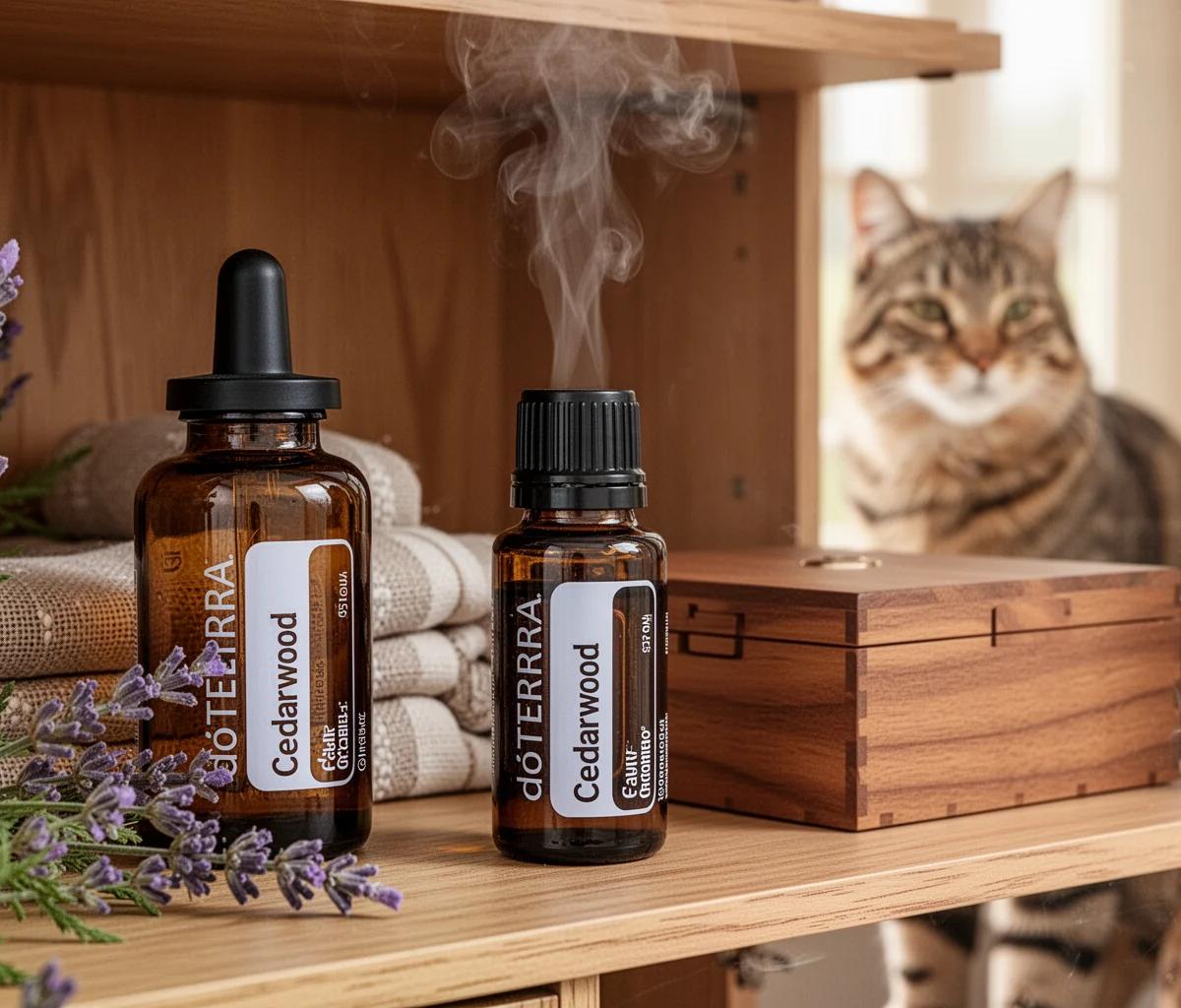
- If you use a doTERRA diffuser for yourself, place it in a room where your cat does not spend time, and keep the door closed after. Our Cedarwood, for instance, stays in a home office the cats never enter.
- If your cat ever shows signs like drooling, wobbling, pawing at their mouth, or unusual lethargy and you suspect oil exposure, contact your veterinarian or an animal poison control center immediately. This is not a “wait and see” situation.
The oils I use most often around our own home, with those precautions in place, tend to be gentler options like Frankincense and Lavender, both stored well out of reach and used sparingly in well-ventilated spaces after a conversation with our vet. For a calm shared environment, I also keep Roman Chamomile and Copaiba in my collection, but again, only where air circulates freely and the cats can walk away at any time.
Related reading
- Tea Tree Oil and Cats, A Serious Danger
- Safe doTERRA Oils for Cats, What I Know
- doTERRA for Cat Owners Getting Started
Frequently Asked Questions
Can I diffuse doTERRA oils if my cat is in another room?
If the room is separated by a closed door and has good ventilation, and the oil you are diffusing is not one of the high-risk ones listed for cats, many veterinarians will say it is reasonable. But every home and every cat is different. You should always ask your own vet about your specific layout and your specific pet.
Is lavender safe for cats?
Lavender is gentler than oils like Tea Tree or peppermint, but no essential oil is truly safe for cats in the way it might be for dogs or humans. Some cats can still react. We keep it, but we treat it with the same caution we give every other oil.
What should I do if my cat accidentally licks an essential oil?
Do not wait and do not try a home remedy. Contact your veterinarian or a pet poison control hotline immediately. Have the oil bottle with you so you can tell them exactly what was involved. Quick, calm action is the only correct response.
Are there any doTERRA oils made specifically for cats?
doTERRA does not sell essential oils formulated for cats. Some products exist for dogs and horses, but cats are simply too sensitive. Any use around a cat should always start with a veterinarian’s guidance and never involve direct application.
What about Vetiver or Patchouli?
These are not in the highest-risk group, but the rule still applies: talk to your vet before introducing any new oil into a home with a cat. What is mild to one animal can be a problem for another, and cats hide discomfort until it is significant.
A Calm Home Is a Cautious One
Living well with cats and essential oils is not about fear, it is about respect. We love the aromas and the rituals oils bring into our home, and we love the animals who share it even more. Knowing which bottles to keep on a high shelf and when to call the vet is not restrictive, it is the foundation of a home where everyone, on four legs and two, feels good.
For further reading on oils that pose the highest risk to cats, see our guide on the essential oils most toxic to felines.
This content is for general information only and is not veterinary advice. Always consult a qualified veterinarian before using essential oils in a home with animals.