Is Lavender Oil Safe for Dogs
Wondering if lavender oil is safe for your dog? Learn the real risks, why diffusion matters, and what every pet owner should ask their vet first.
By the EssentialTail Team — pet owners, Wellness Advocates & doTERRA enthusiasts
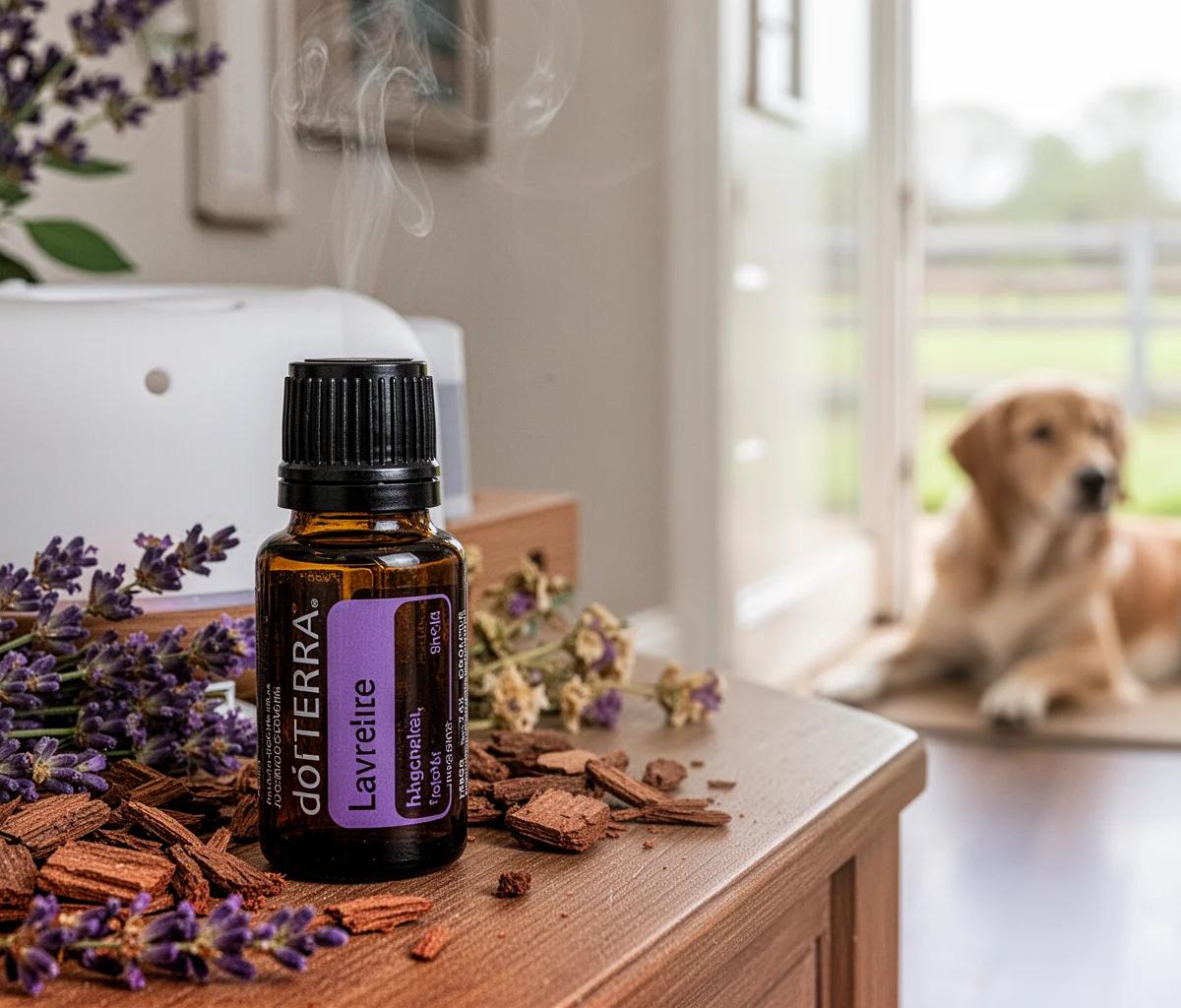
I remember the first time I unscrewed the cap on a bottle of lavender oil while my golden retriever dozed nearby. She lifted her head, gave the air a long sniff, and then settled right back into her nap. I wondered: is this actually okay for her, or am I making a mistake?
The short answer is that lavender oil can be used in a home with dogs, but only under very specific conditions. It is never something to apply directly to your dog’s skin or fur without a veterinarian’s explicit guidance, and diffusion must always happen in a well-ventilated space the dog can leave freely. Many dog owners know lavender for its familiar, floral aroma in shared living rooms, but a pleasant scent for us does not automatically equal compatibility for a dog’s sensitive nose. The real deciding factor is how you use it, how much, and whether your individual dog tolerates it.
What Makes a Quality Lavender Oil Different
When I talk about lavender with fellow dog owners, the conversation always circles back to purity. A lavender oil that contains synthetic fillers or unknown adulterants introduces variables you cannot control, and when a dog’s respiratory system is involved, unknowns are the last thing you want.
In our experience, the value of a standard like doTERRA’s Lavender lies in the transparency. Knowing it is steam-distilled from Lavandula angustifolia grown in Bulgaria and tested through the CPTG process means you are working with a single, well-documented botanical, not a mystery blend. That matters because it lets you and your veterinarian make an informed decision about exposure.
Still, purity is not an all-clear for unlimited use around dogs. Even the cleanest lavender oil is a concentrated plant extract, and in a confined space, any strong aroma can overwhelm a dog’s nose. That is why many owners pair lavender with a diffuser that offers intermittent settings, so the scent never becomes a constant, heavy layer in the room. The Lumo Diffuser is one I see recommended often because its run cycle gives the air a break, which is kinder to a dog that cannot tell you the smell is too much.
| Diffusion Factor | Why It Matters for Dogs |
|---|---|
| Ventilation | An open door or window lets the dog’s nose reset. |
| Room size | Larger, airy rooms dilute the aroma naturally. |
| Exit route | A dog must be able to walk out at any moment. |
| Duration | Short, intermittent sessions are gentler than hours-long runs. |
How I Approach Lavender Diffusion With a Dog at Home
Everyone’s home is laid out differently, and there is no single set-up that works for all dogs. What I can share is the step-by-step routine I settled into after talking with my own vet. It is built around giving the dog the final say, every single time.
- Ask your veterinarian first. Before the diffuser ever gets plugged in, have a conversation with the vet who knows your dog’s respiratory health, age, and breed sensitivities. This is the non-negotiable first step, not a formality.
- Choose the largest, most open room. I use the living room rather than a bedroom or hallway, because the volume of air is greater and the scent dissipates faster.
- Place the diffuser where the dog cannot knock it over. A sturdy side table well out of tail-wag range avoids a spill that could lead to skin contact or accidental ingestion.
- Use the shortest timer setting available. A brief burst is enough to notice the aroma without saturating the room.
- Observe your dog’s body language. If she yawns more, squints, walks to another room, or seems restless, I switch the diffuser off immediately. Her comfort is the only metric that counts.
If your dog shows any sign of respiratory distress, drooling, or unusual lethargy, stop the diffusion at once and call your veterinarian or an animal poison control center. That immediate, no-hesitation response is the backbone of responsible use.
For owners who prefer a diffuser built for larger common areas, the Petal Diffuser covers more square footage while still offering a gentle mist output. The principle stays identical: open space, animal exit, and a vet’s input first.
Related reading
- Is Tea Tree Oil Safe for Dogs
- Can You Use Lavender Oil in a Dog Bath
- Can I Use Lavender Oil on My Dogs Paws
Frequently Asked Questions
Can I put lavender oil directly on my dog’s collar or bedding?
No. Even diluted, oil on fabric or fur puts the aroma right at the dog’s nose with no escape. That constant proximity can be irritating at best and risky at worst. Always discuss any topical use with your veterinarian before trying it.
Is lavender oil safer for dogs than other essential oils?
Every oil is a distinct chemical profile, and “less risky” is not the same as “safe.” While lavender is discussed in pet-owner communities more often than, say, tea tree or wintergreen, that does not mean it is safe for all dogs or all situations. Your vet’s guidance for your specific dog is the only safety call that matters.
What should I do if my dog licks spilled lavender oil?
Contact your veterinarian or an animal poison control center right away. Do not wait for symptoms to appear, and do not attempt to induce vomiting or give food or water unless a professional tells you to. Rapid professional evaluation is the only correct response.
For more on choosing oils when a diffuser is part of your home, our overview of safe essential oils for dogs diffuser walks through what to consider across several popular oils. If you are looking specifically at the doTERRA line, doTERRA oils gentle enough for dogs covers a broader set of single oils and blends that owners often ask about.
Lavender oil and dogs can coexist in the same home when we lead with caution, stay alert to our animal’s signals, and never skip the veterinarian’s phone call. The goal is never to push the boundaries of what a dog can tolerate; it is to create a home that feels good for everyone on four legs and two.
Adaptiv · Arborvitae · Balance · Console
This content is for general information only and is not veterinary advice. Always consult a qualified veterinarian before using essential oils in a home with animals.