Essential Oil Diffuser Safety With Pets
Learn how to use an essential oil diffuser responsibly around dogs, cats, and other pets with vet-first guidance and practical safety steps.
By the EssentialTail Team — pet owners, Wellness Advocates & doTERRA enthusiasts
You have just unboxed a new diffuser, and before the first mist appears, your cat jumps onto the counter. I know that look. The short answer on diffuser safety with pets is this: it is possible to enjoy aromas in a shared home, but only with serious precautions, because animals process scents very differently from us. Never diffuse in a room your pet cannot leave. Keep the diffuser out of reach, use only a small amount, and always check with your veterinarian first, especially with cats, birds, rabbits, or rodents. Many essential oils are risky or even toxic to certain species. The safest place to begin is your vet, not an online list.
Which Oils Call for the Most Caution
Cats sit at the top of the caution list. Their bodies lack a key enzyme that helps metabolize many plant compounds, so oils like oregano, thyme, cinnamon, clove, and especially tea tree can be genuinely dangerous. Citrus oils, peppermint, eucalyptus, and wintergreen are also ones I keep far away from feline noses. Birds and small mammals have extremely sensitive airways, so diffusing around them is not something I would ever do without an avian or exotic veterinarian’s explicit approval.
Dogs tolerate more than cats, but that is not a green light. A veterinarian should still guide any choice. For homes with mixed species, the most conservative approach wins: the animal with the highest sensitivity sets the rules. This is exactly why I keep returning to diffusing essential oils safely around pets as a refresher whenever friends ask me about it.
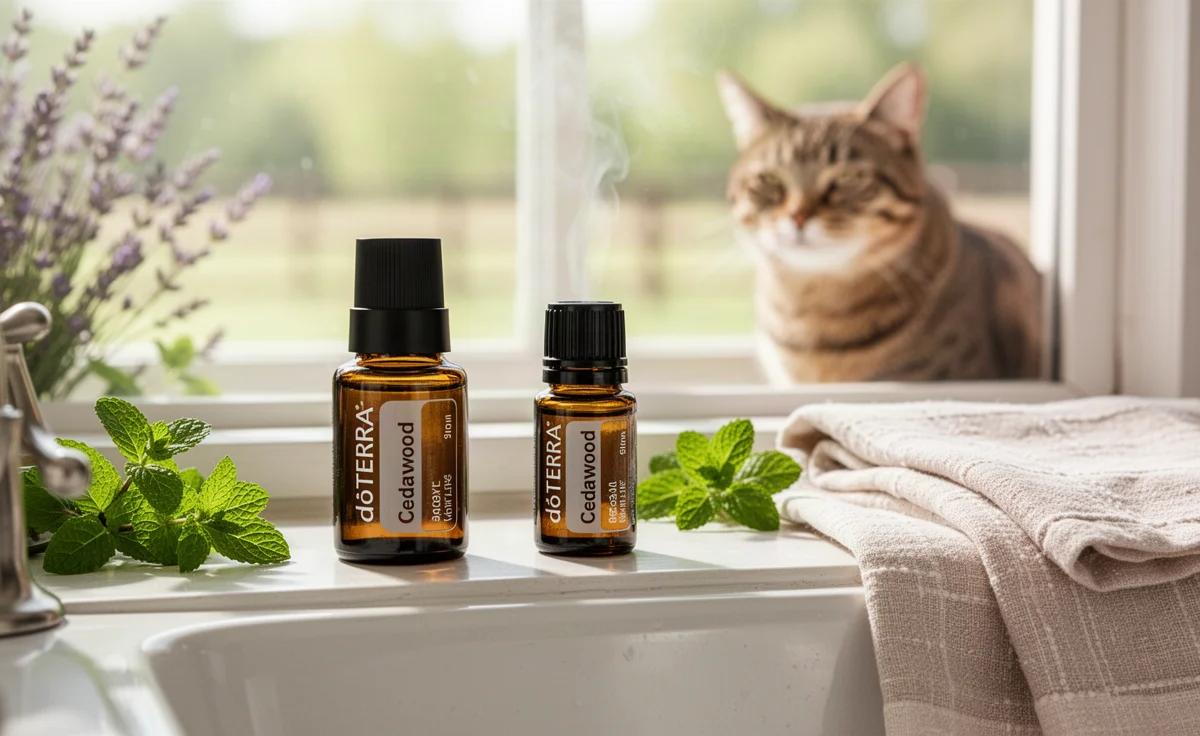
When I want a grounded, woody aroma in a dog-friendly space, I tend to reach for something like Cedarwood, used sparingly and with the door open. Its warm, forest-floor scent feels calm without being loud in the room. For a softer floral note, many owners I know enjoy Roman Chamomile, though I always describe it as a personal preference, never a pet remedy. The same goes for Frankincense, which I appreciate for its rich, resinous character. None of these are safe for every animal, so the vet conversation still comes first. What draws me to doTERRA here is not a health promise but the CPTG testing discipline behind each bottle, that each batch is checked for purity and identity before it ever reaches my home.
A few oils I simply never diffuse in a house with animals. Tea tree is plain text in my mind, never a shopping link, because its risk to cats is too well documented. The same applies to eucalyptus, wintergreen, pine, most citrus oils, and peppermint. If you are ever unsure whether a specific oil is a problem for your species, the ASPCA Animal Poison Control Center and the Pet Poison Helpline are the resources I name first, alongside my own veterinarian.
A Practical, Vet-First Routine for Shared Homes
Here is the checklist I actually follow, step by step, whenever a diffuser runs in a home that includes an animal.
- Ask the veterinarian before introducing any new oil. Species, age, weight, and health all change the answer, and only a vet knows your animal's full picture.
- Choose a room with open ventilation and a clear exit. The animal must be able to walk away at any moment, no closed doors and no tiny bathroom running mist while a cat naps on the bath mat.
- Place the diffuser where paws and tails cannot reach it. A curious dog can knock a diffuser off a side table in seconds, and a spill means a different kind of emergency.
- Use a small amount, far less than you would in a pet-free room. I describe it as barely-there, a whisper of scent rather than a cloud.
- Watch the animal, not your phone. Ears back, hiding, sneezing, drooling, unsteady movement, or sudden avoidance are all signals to stop, open windows, and call the vet immediately.
- Never add oils to an animal's water, food, or skin. Diffusion is already enough of a question mark without adding ingestion or topical exposure to the mix.
| Situation | What I Do |
|---|---|
| Cat in the home | Skip risky oils entirely, diffuse only in a room the cat can leave, vet approval first |
| Bird, rabbit, or rodent present | Do not diffuse at all without an exotic vet's explicit yes |
| Dog only, healthy adult | Vet approves, ventilated shared space, tiny amount, constant observation |
| Any pet shows discomfort | Turn diffuser off, open windows, call vet or poison control right away |
For anyone looking for a gentler starting point, I appreciate the aroma of Copaiba, which is mild and woodsy without being sharp. Vetiver, with its deep, earthy presence, is another one I use very lightly. Both still require the same vet-first rule, because no oil is automatically safe around an animal simply because it comes from a plant. The diffusing oils around pets the safe way guide walks through this same territory from a slightly different angle, and I find it useful to revisit before changing anything in our routine.
For an open, airy home feel, I sometimes reach for Lavender because its floral-herbal character feels approachable to me. And when I want a crisp, clean atmosphere in a pet-free corner of the house, Purify is a blend I genuinely enjoy for its bright, cleansing aroma. The point is never to treat an animal with scent. The point is to live well in the same space, with the animal's comfort holding the veto.
Related reading
- Calming Oil Safe Around Dogs Cats and Birds
- Non Toxic Diffuser Oils for Bird and Dog Homes
- Diffusing Essential Oils Around Birds and Small Pets
Frequently Asked Questions
Can I diffuse essential oils if I have a cat?
It depends entirely on the oil, the room, and your cat's health, and the only person qualified to answer is your veterinarian. Many oils are risky for cats, so I would never diffuse in a room a cat cannot leave, and I would avoid tea tree, eucalyptus, citrus, peppermint, and phenolic oils altogether.
What should I do if my pet has a bad reaction to a diffuser?
Turn the diffuser off and open the windows immediately. Then contact your veterinarian or an animal poison control center such as the ASPCA Animal Poison Control Center or the Pet Poison Helpline right away, without waiting to see if it passes.
Is it safer to put essential oils on a pet instead of diffusing?
No. Topical use on animals is a veterinary decision, never a home experiment, and many oils can harm skin or be absorbed in ways that cause serious problems. Ingestion is even more dangerous, so oils should never go in water, food, or directly on your pet.
Are some diffuser oils safer than others around dogs?
Dogs may tolerate certain oils better than cats do, but that does not make any oil automatically safe for every dog. A calm, woodsy aroma like cedarwood or copaiba might feel gentle to you, yet your veterinarian should still approve it for your specific dog and living space.
How do I know if a diffuser is too strong for my pet?
Watch the animal closely. Pawing at the face, sneezing, drooling, hiding, restlessness, or sudden attempts to leave the room all suggest the scent is too much. Reduce or stop diffusion, ventilate the space, and ask your vet for guidance.
Diffusing around pets is not about finding a loophole. It is about respecting that their noses and bodies are not ours, and that the most loving choice is often the most cautious one. When in doubt, I skip the diffuser for the evening and enjoy a quiet, unscented room with my animals instead.
This content is for general information only and is not veterinary advice. Always consult a qualified veterinarian before using essential oils in a home with animals.