Safe doTERRA Oils for Older Cats with Anxiety
Wondering which doTERRA oils are safe for older anxious cats? I share what I know about gentle aromas, vet first, and what to truly avoid. A practical guide.
By the EssentialTail Team — pet owners, Wellness Advocates & doTERRA enthusiasts
I know how it feels to watch an older cat pace the hallway at dusk, meowing at nothing in particular. You just want to help them settle. If you are reading this, you are probably wondering whether the diffuser you love can play a gentle role in your senior cat's life, and the honest answer is this: the safest "oil" for an anxious older cat is a conversation with your veterinarian before anything else. Cats process essential oils very differently than we do, and older cats often have kidneys, livers, or lungs that are less forgiving. So no, I will never hand you a list of "calming kitty oils" and call it a day. What I can do is share what many cat loving doTERRA households actually do, which oils tend to be discussed most gently, and where hard caution applies. Always with the vet as the first call.
Understanding Why Cats Are Different
Cats are not small dogs, and they are certainly not small humans. Their livers lack certain enzymes that help break down compounds found in many essential oils. That means what smells lovely to you can linger in a cat's system far longer than it should. This is why I treat every oil conversation involving a cat, especially an older one, with far more caution than a dog conversation.
The ASPCA Animal Poison Control Center and the Pet Poison Helpline both stress that cats are particularly sensitive to many concentrated plant compounds. They advise that any accidental exposure, licking, or odd behavior after diffusing should prompt an immediate call to a veterinarian or poison control center. I have learned to keep those numbers saved in my phone, not because I plan to use them, but because I never want to scramble if something goes wrong.
When I read about cats and oils, I return to one rule: the cat must always be able to leave the room. Diffusion in a closed bathroom or bedroom with a sleeping senior cat is a hard no for me. Open space, open door, and plenty of fresh air matter far more than which oil is in the water.
What Some Owners Do Instead of Diffusing Near Cats
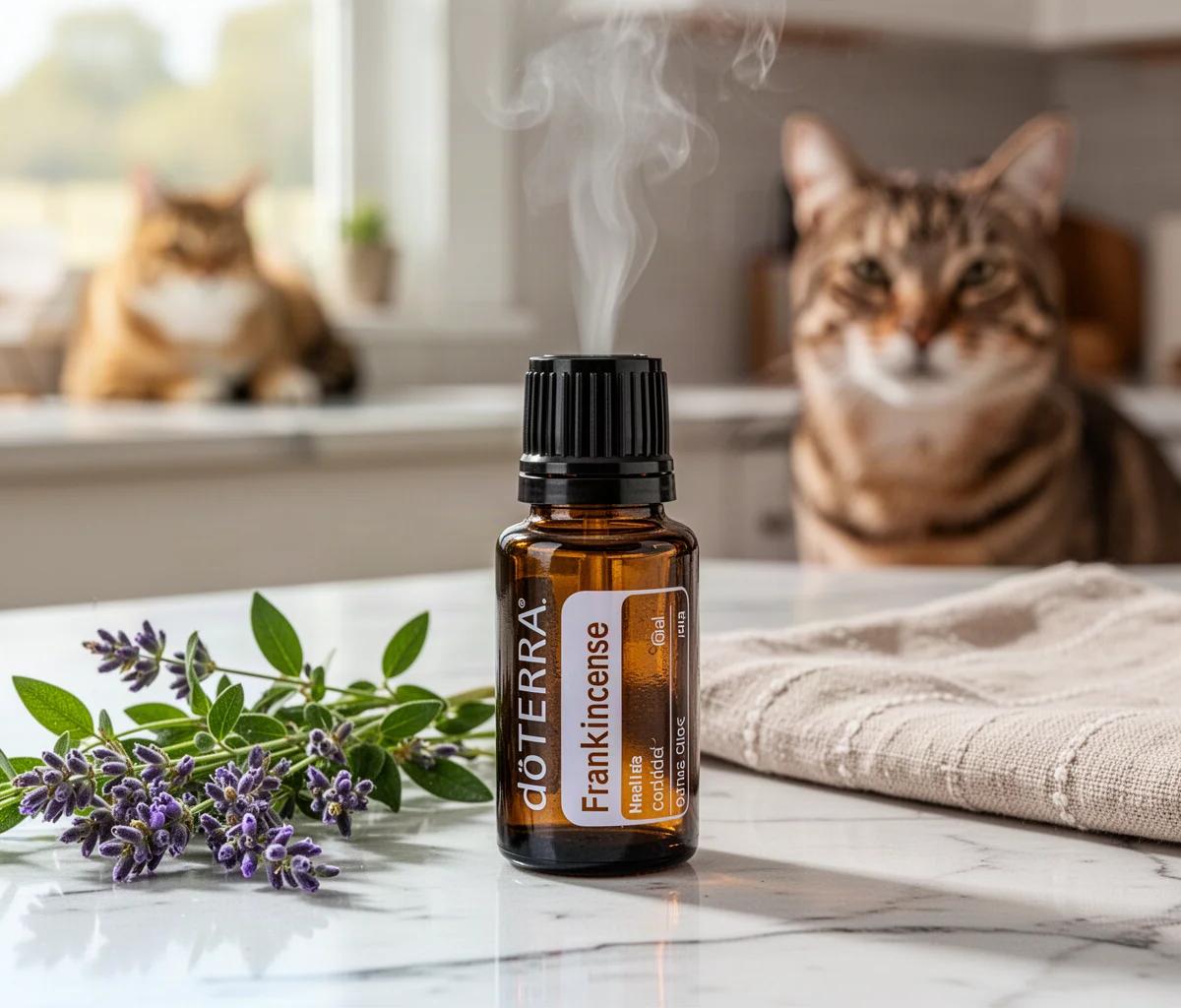
Many cat owners I know choose to keep their own calming oils entirely separate from their cat's space. For example, I will diffuse Frankincense in my office with the door closed long before my cat comes in. By the time she enters, the aroma has settled, and the diffuser is off. This is an experiential choice, not a feline dose, and I still ran it past my vet first.
Another approach I have seen work well is using unscented, cat-specific comfort routines that have nothing to do with oils. Warm bedding, predictable feeding times, and a quiet perch by a window often do more for an older cat's restlessness than any bottle on a shelf. When I do reach for doTERRA, I lean toward oils known in our community for soft, grounding aromas rather than sharp or camphorous ones. Roman Chamomile and Vetiver are two oils I hear mentioned in calm human contexts, but again, I would never present them as a feline supplement.
Here is the simple step by step I follow when any oil might share air with my cat:
- Ask my veterinarian first, naming the exact oil and how I plan to use it.
- Diffuse only in a large, well ventilated room the cat can freely leave.
- Use a very small amount, far less than I would in a pet free home.
- Watch my cat for any change in breathing, drooling, or hiding.
- Stop immediately and call the vet if anything feels off.
The reason to choose doTERRA at all, for me, is purity. The brand's CPTG testing standard means I know what is in the bottle, which matters when you are trying to reason about risk. A pure oil is still not automatically safe for a cat, but knowing the label and the testing gives me a clearer starting point for a vet conversation. I have written more about this in my piece on Safe doTERRA Oils for Cats, What I Know, and for the harder side of the coin, I keep coming back to my guide on doTERRA Oils and Cats What to Truly Avoid.
Oils I Keep Completely Away From Cats
Some oils are simply non negotiable for me around cats. Tea Tree, which doTERRA sells as a pure single, is one I will not even open in the same room. The same goes for Oregano, Thyme, Cinnamon, Clove, and most citrus oils like Lemon or Wild Orange. Peppermint, Eucalyptus, Wintergreen, and pine oils also stay far away. These are not mild preferences. Many of these oils contain compounds that cats cannot efficiently clear, and in an older cat that risk only grows.
Below is a quick comparison of how I think about a few commonly discussed oils in cat households:
| Oil / Blend | What I Do Around Cats | Why |
|---|---|---|
| Frankincense | Diffuse only in a separate, closed room before cat enters | Soft aroma, but still not a feline approval |
| Roman Chamomile | Discuss with vet first, never apply to cat | Often used gently by humans, but cats are not small humans |
| Vetiver | Keep in my own space, never on the cat | Grounding aroma for me, not a pet protocol |
| Tea Tree | Never open around cats | Known to be especially dangerous for cats |
| Lemon / Wild Orange | Never diffuse in shared cat space | Citrus compounds are a hard avoid for me |
| On Guard | Never diffuse near cats | Contains several oils I avoid around cats entirely |
For households that also have dogs, I have found that Copaiba and Cedarwood are oils some dog owners mention because of their soft, woody warmth, though again, every animal is individual and the vet remains the filter for both species. I never assume a dog friendly oil is cat friendly. They are different animals with different livers, different lungs, and different risks.
Related reading
- Which Oil Calms Cats for Vet Visits
- Safe Essential Oil Spray for Cat Bedding
- Gentle Aromatherapy for Senior Cat Bedtime
Frequently Asked Questions
Can I diffuse any doTERRA oil around my older cat? No, and I would not suggest it. Cats are extremely sensitive to many essential oils, and older cats often have less physiological reserve. The only responsible answer is to ask your veterinarian before diffusing anything in a home with a cat.
Which doTERRA oil is safest for cats? I do not label any oil as safe for cats. Even oils that many humans use gently, like Roman Chamomile or Frankincense, are not automatically feline safe. In our experience, the best practice is separation, ventilation, and a vet's sign off rather than a specific bottle recommendation.
What should I do if my cat licked or spilled an essential oil? Contact your veterinarian or an animal poison control center immediately. Do not wait, do not offer home remedies, and do not try to make the cat vomit. Emergencies belong in professional hands right away.
Is doTERRA Tea Tree okay for cats? No. I keep Tea Tree completely away from my cat at all times. It is one of the oils most consistently flagged as dangerous for cats, and I treat it as a hard boundary in our home.
A Gentle Ending
An older cat's restlessness is hard to watch, and I truly understand wanting to bring softness into their space. For me, the softest thing I can do is ask my vet first, keep oils and cats politely separated, and let warmth come from routine and presence more than from a diffuser. That is the kind of calm I can stand behind.
This content is for general information only and is not veterinary advice. Always consult a qualified veterinarian before using essential oils in a home with animals.